Tell us about the job
Takes about a minute. No obligation.
A contractor called out to a Wells County furnace repair is not walking in blind, but the diagnosis starts with the unit itself: how old it is, how it has been serviced, and which components show wear from sustained use. 68 severe weather events were recorded in Wells County, Indiana between 2015 and 2024. That record means furnaces here have operated against genuine seasonal stress, and parts like heat exchangers, igniters, and blower motors do carry that load over time. Even so, most furnace failures a contractor finds in this county trace to age and deferred maintenance rather than to weather alone, and that distinction changes which parts get ordered and what the repair bill looks like.
Half the homes in Wells County, Indiana were built in 1973 or earlier (2020-2024 ACS 5-year). A furnace that has been swapped out once or twice since the house was built can still carry parts whose manufacturers have discontinued the line entirely. When a contractor opens a heat exchanger or a control board in stock this old, the question is whether what failed can be sourced as a direct replacement or has to be cross-referenced against current equivalents, and those two paths produce different repair scopes and different timelines. Wells County homeowners should know that age of the house sets the context, but it is the age of the specific components inside it that determines whether a repair is a same-week fix or a longer parts search.
The Parts of a Furnace a Contractor Checks First
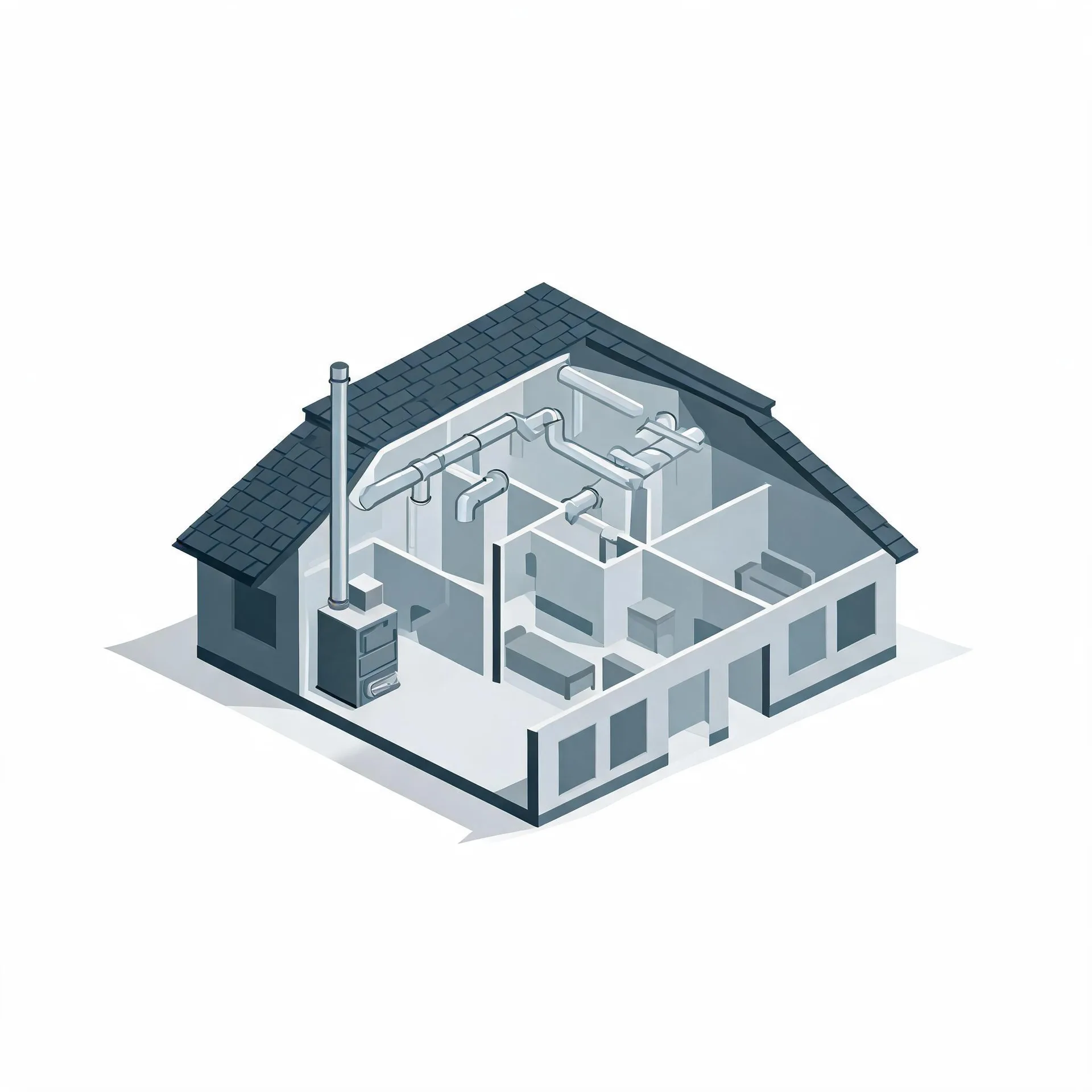
The heat exchanger sits at the core of the furnace cabinet in the basement or utility space and is the piece that actually warms the air. Cracks or corrosion there mean combustion gases can reach the living space, so a contractor looks at it closely. The burners sit just below it and are often the first suspect when the furnace runs but produces little heat.
The blower motor and its fan wheel sit at the base of the cabinet and push conditioned air into the supply side of the duct system. The inducer motor pulls combustion gases out through the flue and runs just before the burners fire. The control board ties both of those together and is where a contractor reads fault codes when a symptom does not point clearly to a single part.
The drawing shows a typical furnace layout, and a licensed contractor determines which components and conditions apply to your specific system.
Find a contractor in Wells CountyWells County, Indiana, by the numbers
68 severe weather events were recorded in Wells County, Indiana between 2015 and 2024.
NOAA National Centers for Environmental Information, Storm Events Database, bulk CSV export, events 2015-01-01 through 2024-12-31.Half the homes in Wells County, Indiana were built in 1973 or earlier (2020-2024 ACS 5-year).
U.S. Census Bureau, 2020-2024 American Community Survey 5-Year EstimatesWells County, Indiana holds 12,074 housing units (2020-2024 ACS 5-year).
U.S. Census Bureau, 2020-2024 American Community Survey 5-Year EstimatesOwners occupy 75.6% of the occupied homes in Wells County, Indiana (2020-2024 ACS 5-year).
U.S. Census Bureau, 2020-2024 American Community Survey 5-Year EstimatesCodes & Standards Covering Furnace Repair in Wells County, Indiana4 sourced rules and standards
What Happens When a Contractor Comes Out
Non-weatherized gas furnaces manufactured on or after November 19, 2015 must reach 80.0 percent AFUE.
Non-weatherized oil-fired furnaces manufactured on or after November 19, 2015 must reach 83.0 percent AFUE.
Mobile home gas furnaces manufactured on or after November 19, 2015 must reach 80.0 percent AFUE.
Non-weatherized gas furnaces manufactured on or after December 18, 2028 must reach 95.0 percent AFUE, up from the 80.0 percent minimum that applies to units manufactured before that date.
Severe Weather Events in Wells County
Heating equipment in Wells County works against whatever the weather puts it through, and hard weather years leave marks on furnaces that show up as repair calls. How much stress the local climate puts on that equipment is a local fact.
68 severe weather events, 2015–2024. Source: NOAA National Centers for Environmental Information, Storm Events Database.