Tell us about the job
Takes about a minute. No obligation.
A contractor quoting furnace repair in Newton County spends time on installation quality, filter history, and heat exchanger condition before considering what the climate may have contributed. 61 severe weather events were recorded in Newton County, Indiana between 2015 and 2024. At that rate, severe weather is an occasional event in this area rather than a standing operating pressure on equipment. A furnace that breaks down here is more likely to show worn igniter contacts, cracked heat exchanger sections, or a blower motor that ran past its service life than anything weather-driven. Age and maintenance history are where the diagnosis starts.
Half the homes in Newton County, Indiana were built in 1971 or earlier (2020-2024 ACS 5-year). A furnace installed into a house that old sits on top of whatever ducting and wiring were already threaded through it, and the system running today is not the original one. What a contractor finds once the unit is open is a repair question, but whether the parts that unit takes are still manufactured is what determines the bill. Older equipment generations cycle out of parts availability, and a diagnosis that identifies the failed component still has to clear that second hurdle before the job can close.
The Parts of a Furnace a Contractor Checks First
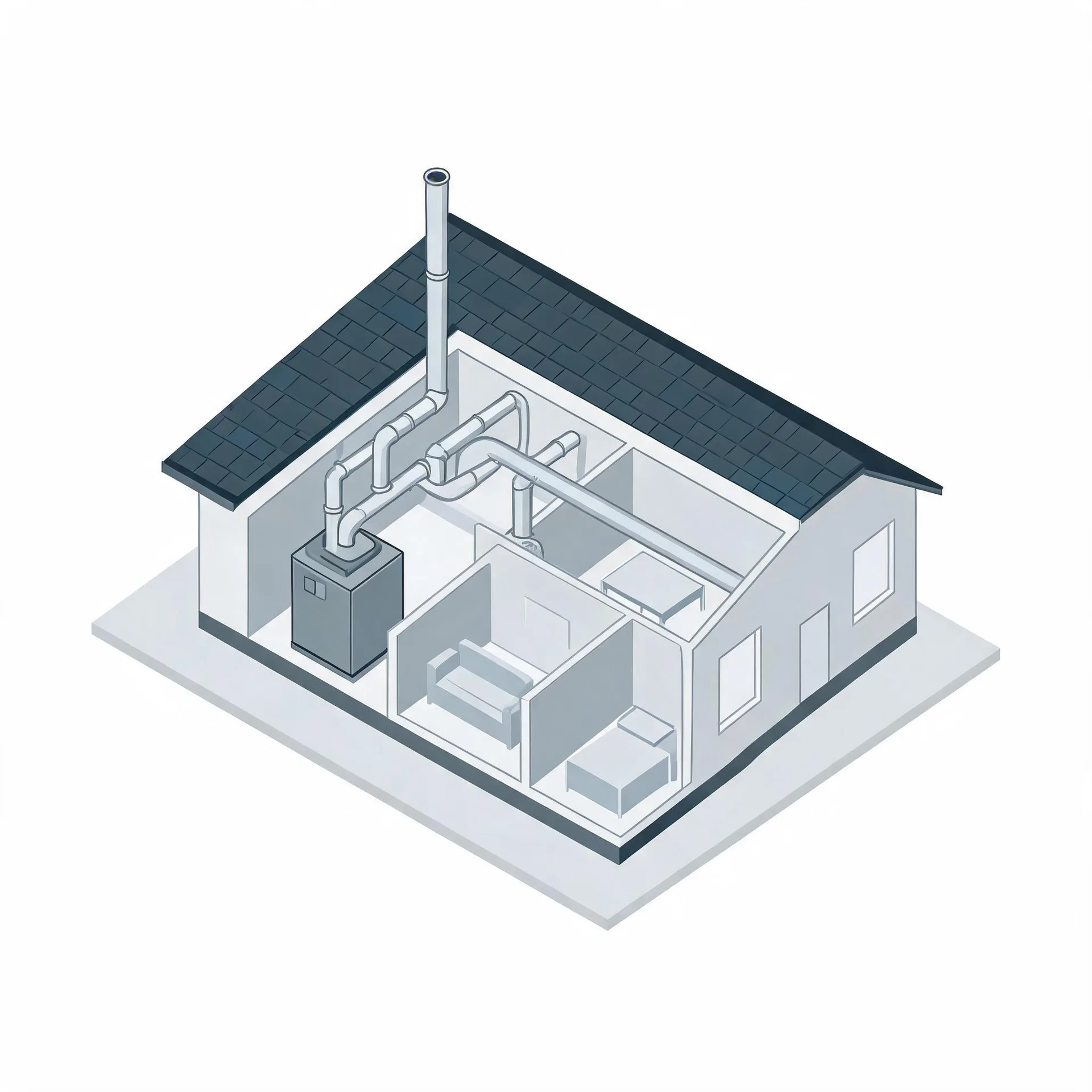
The furnace itself sits in a basement, utility room, or closet and is the piece a contractor goes to first. Inside it, the heat exchanger is the part most likely behind a no-heat call. The burners feed it, and the blower motor pushes air across it and out into the house.
The flue pipe runs from the furnace to an outside wall or up through the roof, carrying combustion gases out. Alongside the furnace sits the filter housing, where a clogged filter can starve the blower of airflow and send the whole system into a fault. The thermostat on a living-room wall tells the furnace when to fire.
The drawing shows a typical layout, and a licensed contractor determines which parts apply to your specific home and system.
Find a contractor in Newton CountyNewton County, Indiana, by the numbers
61 severe weather events were recorded in Newton County, Indiana between 2015 and 2024.
NOAA National Centers for Environmental Information, Storm Events Database, bulk CSV export, events 2015-01-01 through 2024-12-31.Half the homes in Newton County, Indiana were built in 1971 or earlier (2020-2024 ACS 5-year).
U.S. Census Bureau, 2020-2024 American Community Survey 5-Year EstimatesNewton County, Indiana holds 6,093 housing units (2020-2024 ACS 5-year).
U.S. Census Bureau, 2020-2024 American Community Survey 5-Year EstimatesOwners occupy 81.1% of the occupied homes in Newton County, Indiana (2020-2024 ACS 5-year).
U.S. Census Bureau, 2020-2024 American Community Survey 5-Year EstimatesCodes & Standards Covering Furnace Repair in Newton County, Indiana4 sourced rules and standards
What HVAC Repair Looks Like in Newton County
Non-weatherized gas furnaces manufactured on or after November 19, 2015 must reach 80.0 percent AFUE.
Non-weatherized oil-fired furnaces manufactured on or after November 19, 2015 must reach 83.0 percent AFUE.
Mobile home gas furnaces manufactured on or after November 19, 2015 must reach 80.0 percent AFUE.
Non-weatherized gas furnaces manufactured on or after December 18, 2028 must reach 95.0 percent AFUE, up from the 80.0 percent minimum that applies to units manufactured before that date.
Severe Weather Events in Newton County
Extreme weather puts real strain on heating equipment, cycling it hard through temperature swings it was not built to absorb indefinitely. How much of that strain a furnace carries depends on where it runs, which makes local weather history a direct part of the repair picture.
61 severe weather events, 2015–2024. Source: NOAA National Centers for Environmental Information, Storm Events Database.