Tell us about the job
Takes about a minute. No obligation.
A contractor called out for furnace repair in DeKalb County works through the same diagnostic priorities that hold almost anywhere: heat exchanger condition, ignition components, and whether the system has been serviced regularly. 66 severe weather events were recorded in DeKalb County, Indiana between 2015 and 2024. At that rate, severe weather is an event this equipment encounters, not a steady load it has been grinding against. A furnace that quits in January is almost always telling you something about its age or how it has been maintained, not about what the sky has thrown at the county. The contractor's first questions are about service history and the condition of wear parts, because that is where the answer almost always sits.
Furnace systems in a house this old were chosen to fit what the house already had, not the other way around. Half the homes in DeKalb County, Indiana were built in 1975 or earlier (2020-2024 ACS 5-year). That history matters at the repair stage because the contractor opening a furnace here finds components tied to an older generation of equipment, and parts availability for that generation is not guaranteed. If a heat exchanger or a control board has gone out of production, a repair that looks routine on the estimate can become a parts search or a recommendation to replace. That is the variable a quote has to account for before any price is final.
The Parts of a Furnace a Contractor Checks First
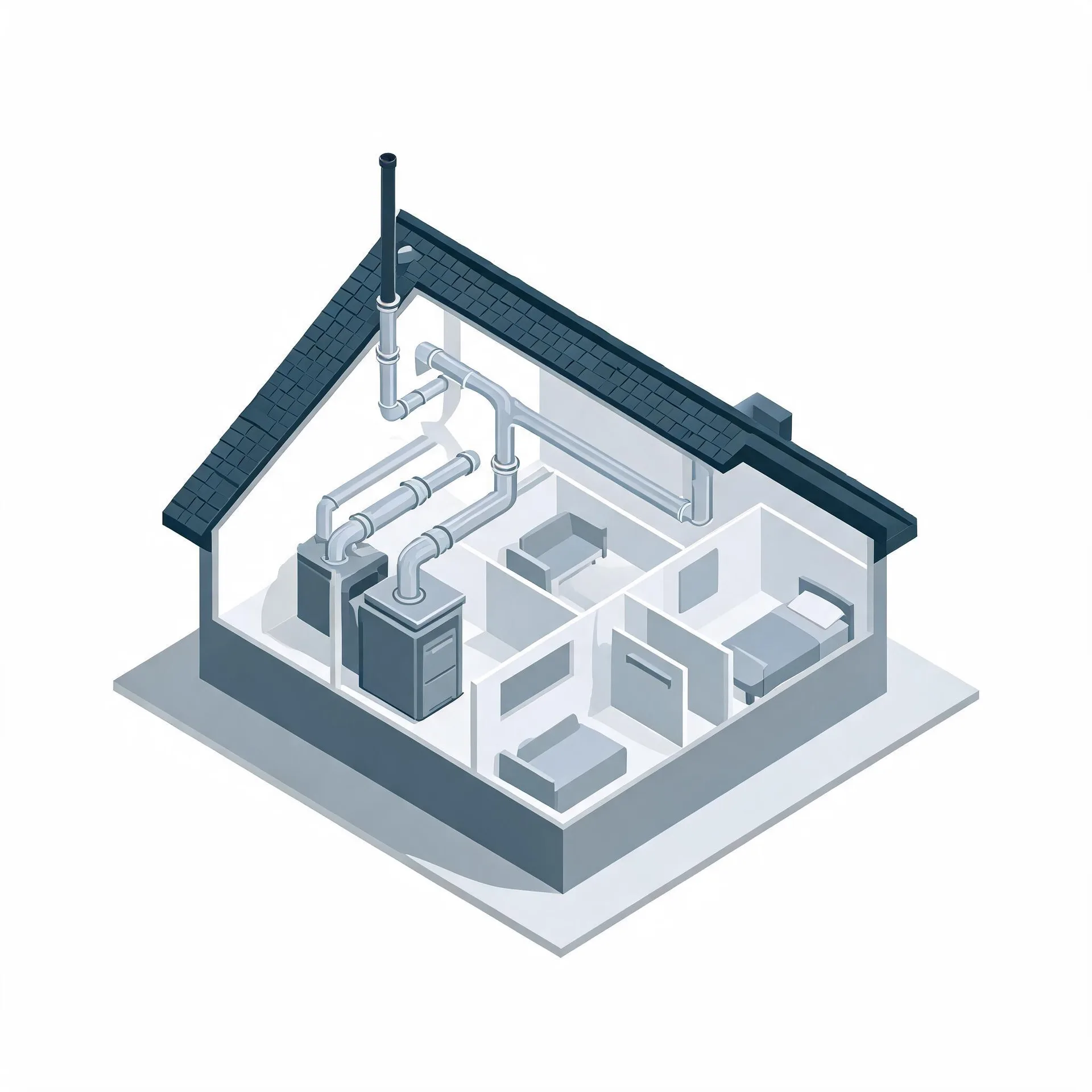
The furnace cabinet sits in a basement, utility room, or closet and houses the burner assembly, heat exchanger, and blower motor. The burner assembly is where fuel ignites. When heat is not reaching the living space, a contractor starts here, checking the igniter, burner, and heat exchanger for cracks or failure before moving to anything else.
The flue pipe exits the cabinet and carries combustion gases out of the house. The air filter sits at the cabinet's intake and is a common choke point when airflow is weak. The thermostat, mounted on an interior wall, sends the call for heat and is checked when the furnace runs poorly or not at all.
The drawing shows a typical furnace layout, and a licensed contractor will determine which components apply to your specific system and what work they require.
Find a contractor in DeKalb CountyDeKalb County, by the numbers
66 severe weather events were recorded in DeKalb County, Indiana between 2015 and 2024.
NOAA National Centers for Environmental Information, Storm Events Database, bulk CSV export, events 2015-01-01 through 2024-12-31.Half the homes in DeKalb County, Indiana were built in 1975 or earlier (2020-2024 ACS 5-year).
U.S. Census Bureau, 2020-2024 American Community Survey 5-Year EstimatesDeKalb County, Indiana holds 18,384 housing units (2020-2024 ACS 5-year).
U.S. Census Bureau, 2020-2024 American Community Survey 5-Year EstimatesOwners occupy 82.1% of the occupied homes in DeKalb County, Indiana (2020-2024 ACS 5-year).
U.S. Census Bureau, 2020-2024 American Community Survey 5-Year EstimatesCodes & Licensing That Cover Furnace Repair in DeKalb County, Indiana4 sourced rules and standards
What HVAC Repair Looks Like in DeKalb County
Non-weatherized gas furnaces manufactured on or after November 19, 2015 must reach 80.0 percent AFUE.
Non-weatherized oil-fired furnaces manufactured on or after November 19, 2015 must reach 83.0 percent AFUE.
Mobile home gas furnaces manufactured on or after November 19, 2015 must reach 80.0 percent AFUE.
Non-weatherized gas furnaces manufactured on or after December 18, 2028 must reach 95.0 percent AFUE, up from the 80.0 percent minimum that applies to units manufactured before that date.
Severe Weather Events in DeKalb County
Heating equipment in DeKalb County works against whatever the local climate puts it through, and storm activity is part of that load. A furnace that runs hard through rough weather accumulates wear in ways that a unit in a mild region does not, which is why local service history matters when something goes wrong.
66 severe weather events, 2015–2024. Source: NOAA National Centers for Environmental Information, Storm Events Database.