Tell us about the job
Takes about a minute. No obligation.
A contractor called out to a furnace in Dearborn County works through the same checklist any repair demands: heat exchanger, igniter, limit switches, blower. 87 severe weather events were recorded in Dearborn County, Indiana between 2015 and 2024. That puts severe weather in this county at a moderate level, real enough that a system carries some load from it over the years, but not so heavy that a contractor expects to find storm-driven wear at the center of every diagnosis. What usually explains a failed furnace here is how old the equipment is and whether it has been serviced regularly. A contractor will check for signs of fatigue in the components that age fastest and price the repair from there.
Furnace repairs in Dearborn County turn on what a contractor finds inside the cabinet: a cracked heat exchanger, a burner assembly running out of tolerance, a limit switch that has cycled past its design count. Half the homes in Dearborn County, Indiana were built in 1982 or earlier (2020-2024 ACS 5-year). Housing that age has seen multiple rounds of equipment, which means the furnace a contractor is opening today was not the original, and the parts it takes may sit in a supply chain that is thinning out. That changes how a contractor quotes the job, because a part that exists and a part that ships in a reasonable window are two different things.
The Parts of a Furnace a Contractor Checks First
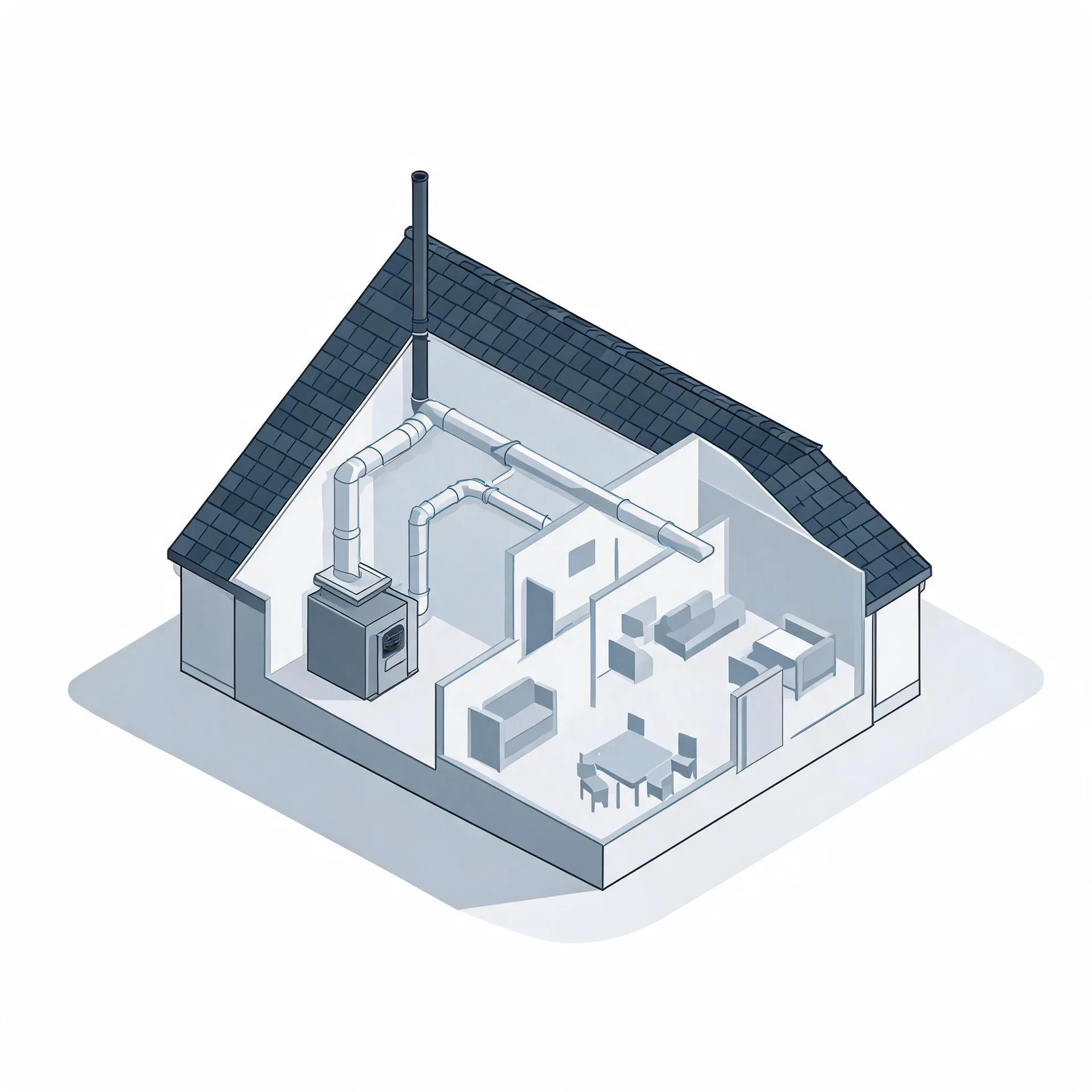
The furnace itself sits in the basement, utility room, or closet and is the piece a contractor goes to first. Inside it, the heat exchanger does the work of warming air, and a cracked or corroded exchanger is one of the more serious findings a repair call turns up. The burners, which fire beneath the exchanger, are checked for uneven flame and buildup that keeps them from lighting cleanly.
The blower motor and its fan wheel sit at the base of the furnace cabinet and push conditioned air out into the supply ducts. The flue or exhaust vent runs from the top of the unit to the outside and carries combustion gases out of the house. The thermostat on the wall and the control board inside the cabinet are both part of what a contractor traces when the system fails to start or cycles incorrectly.
The drawing shows a representative layout, and a licensed contractor determines which components and conditions apply to this particular house.
Find a contractor in Dearborn CountyDearborn County, by the numbers
87 severe weather events were recorded in Dearborn County, Indiana between 2015 and 2024.
NOAA National Centers for Environmental Information, Storm Events Database, bulk CSV export, events 2015-01-01 through 2024-12-31.Half the homes in Dearborn County, Indiana were built in 1982 or earlier (2020-2024 ACS 5-year).
U.S. Census Bureau, 2020-2024 American Community Survey 5-Year EstimatesDearborn County, Indiana holds 21,098 housing units (2020-2024 ACS 5-year).
U.S. Census Bureau, 2020-2024 American Community Survey 5-Year EstimatesOwners occupy 85.2% of the occupied homes in Dearborn County, Indiana (2020-2024 ACS 5-year).
U.S. Census Bureau, 2020-2024 American Community Survey 5-Year EstimatesCodes & Standards Behind Furnace Repair in Dearborn County, Indiana4 rules & standards
What HVAC Repair Looks Like in Dearborn County
Non-weatherized gas furnaces manufactured on or after November 19, 2015 must reach 80.0 percent AFUE.
Non-weatherized oil-fired furnaces manufactured on or after November 19, 2015 must reach 83.0 percent AFUE.
Mobile home gas furnaces manufactured on or after November 19, 2015 must reach 80.0 percent AFUE.
Non-weatherized gas furnaces manufactured on or after December 18, 2028 must reach 95.0 percent AFUE, up from the 80.0 percent minimum that applies to units manufactured before that date.
Severe Weather Events in Dearborn County
Weather puts real stress on heating equipment. Hard conditions demand more of a furnace, and a furnace that works hard is one that needs to be maintained and repaired by someone who knows what the local climate asks of it.
87 severe weather events, 2015–2024. Source: NOAA National Centers for Environmental Information, Storm Events Database.